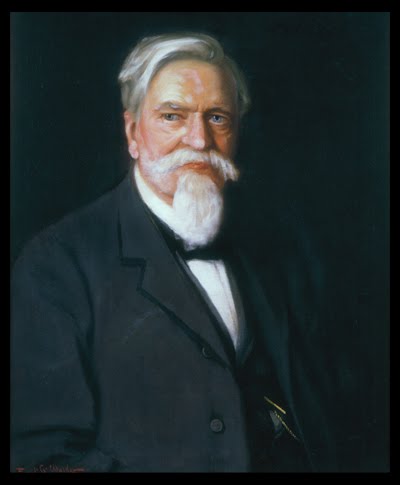
I'm a real bookworm, and I read a lot of books about Kentucky, both fiction and non-fiction. "Basil Duke" is the most interesting and well-written Kentucky book I've read in a long, long while - not just for War Between the States buffs. Duke, as everyone with any sense knows, was John Hunt Morgan's right-hand-man during the war, even taking over his command after his death. So a big chunk of this book is the familiar story of Morgan's Raiders, which has been told in many other excellent books, notably including Ramage's classic "Rebel Raider" and Gorin's recent ”Morgan is Coming!”. But, although Matthews does a great job of covering the war years, the real strength of this book comes in the last chapters which deal with Duke's post-war career in Kentucky politics and business. I have never read a more concise and clear explanation of the oft-quoted old saw "Kentucky joined the Confederacy after the war was over". Through Duke's experiences Matthews really takes you on a tour of the Kentucky of the late 1800s and shows the reasons many loyal Unionist Kentuckians found themselves regretting their position during the war. I'll give you a hint, it had nothing to do with slavery and everything to do with being treated like an occupied enemy territory.
Showing posts with label Civil War. Show all posts
Thursday, February 24, 2011
Kentucky in Print: Basil Wilson Duke, CSA : the Right Man in the Right Place
I'm a real bookworm, and I read a lot of books about Kentucky, both fiction and non-fiction. "Basil Duke" is the most interesting and well-written Kentucky book I've read in a long, long while - not just for War Between the States buffs. Duke, as everyone with any sense knows, was John Hunt Morgan's right-hand-man during the war, even taking over his command after his death. So a big chunk of this book is the familiar story of Morgan's Raiders, which has been told in many other excellent books, notably including Ramage's classic "Rebel Raider" and Gorin's recent ”Morgan is Coming!”. But, although Matthews does a great job of covering the war years, the real strength of this book comes in the last chapters which deal with Duke's post-war career in Kentucky politics and business. I have never read a more concise and clear explanation of the oft-quoted old saw "Kentucky joined the Confederacy after the war was over". Through Duke's experiences Matthews really takes you on a tour of the Kentucky of the late 1800s and shows the reasons many loyal Unionist Kentuckians found themselves regretting their position during the war. I'll give you a hint, it had nothing to do with slavery and everything to do with being treated like an occupied enemy territory.
Tuesday, September 7, 2010
Kentucky Places: Hunt-Morgan House

Nothing quite gets me as fired up and nerdy as talking about the War Between the States, except maybe talking about barbecue. I was raised on stories of how the Yankees burned my great-grandmother's family farm near Colesburg, even though after the war she married a Union soldier. Of course, like many Kentuckians, I have ancestors on both sides of the war (there are dozens of Union and Confederate privates and even a few Confederate generals and congressmen in my family tree) but I've always been more interested in Confederate history; I guess I'm a sucker for a Lost Cause.
When most folks think of Kentucky during the war (if they think of it at all) the first name that comes to mind is General John Hunt Morgan, the Thunderbolt of the Confederacy. Morgan was the epitomy of the Southern cavalier, tall in the saddle, feather in his hat, point Van Dyke on his chin, gallantly riding against the Yankee horde who invaded his beloved Commonwealth. Morgan spent most of the war blowing up bridges and railroads, just generally harassing Union troops and forcing them to waste a lot of time, money, and manpower they would otherwise have used to fight the Confederate Army of Tennessee. A lot of old-timers in Kentucky will tell you they have relatives who rode with Morgan, and there's even a club for them to join the "Morgan's Men Association". I don't belong myself, but as THE old-timer I got to tell you that I have a few ancestors who were in the 8th Kentucky Cavalry CS under Morgan, and one of Morgan's uncles-by-marriage is even in my family tree!
There are a whole bunch of books on Morgan and his men, some of which I'll get around to reviewing one of these days. All over the Commonwealth, from Hopkinsville to Mt Sterling, you can find historical highways markers detailing the exploits of Morgan's Raiders as they hassled the Yanks from behind enemy lines, but if you want a first-hand experience walking in his footsteps you need to visit the Hunt-Morgan House in Lexington. Owned by the non-profit Bluegrass Trust for Historic Preservation, the house was built in 1815 by Morgan's maternal grandfather and saved from the bulldozers in 1955 by a group of preservation minded citizens. Since then the home has been restored to its antebellum glory and it's waiting for you to come and tour it. In addition to the home and period furnishings the house contains a small War Between the States museum complete with saddles and sabres. The coolest items incude General Basil Duke's coat and a scale model of the Morgan statue that graces the Fayette County Courthouse lawn. The house is open seven days a week for guided tours, which cost $7 per adult. There is also a small gift shop for all of your antebellum souvenir needs, and you can even rent out the formal garden for weddings.
I guess I should mention that this isn't really Morgan's house, but his grandfather's and then his mother's. He never lived here as an adult, he lived in a house across the street (which, I should mention, he bought from the very same uncle-by-marriage whi is in my family tree, Colonel Thomas Hart). That house was torn down in 1955 and turned into a lovely parking lot. If it wasn't for the folks at the Bluegrass Trust, this home would also be a parking lot. Which is why you should join.
Sunday, February 21, 2010
Kentucky in Print: Simon Bolivar Buckner, Boderland Knight by Arndt M. Stickles
A reprint of a biography first published in 1940, Boderland Knight is a solid (though fairly uncritical) look at one of most important figures of 19th Century Kentucky. Hart County's Simon Bolivar Buckner was a pretty remarkable man, one who all Kentuckians should know about but few do. At the eve of the War Between the States he commanded the Kentucky State Guard, which was the equivalent of today's Kentucky National Guard. At the war's outbreak he was offered a commission with the Union but instead became a Confederate General. He was blamed by some for the disaster at Fort Donelson, which essential gave Western Kentucky and Tennessee to the Union (although most point the finger to his superior officers). At Donelson he was forced to surrender to his old Mexican War compatriot US Grant, but later their friendship warmed enough for Buckner to serve as one of President Grant's pall-bearers. That kind of puts into perspective the bitterness of the war, or lack thereof, felt by the men at the top - I wonder how many folks realize that the head of all Union armed forces and President of the United States actually requested a Confederate General as pall-bearer (two, actually, General Joseph Johnston being the second). The fols who want get hysterical about Confederate monuments and whatnot should think about that. But I digress...
After the war Buckner became an influential newspaperman before he was elected Governor of Kentucky and spearheaded the adoption of a new state constitution, which is actually the Commonwealth's current state constitution. He really played a pivitol role in Kentucky's history for a half-century, but I've met very few who've even heard his name, which is more than a pity. Buckner really was the epitome of old-time Kentucky, he even looked the part! All things considered, Boderland Knight isn't exactly a page-turner, but until someone writes a new bio it'll have to do.
Subscribe to:
Posts (Atom)